
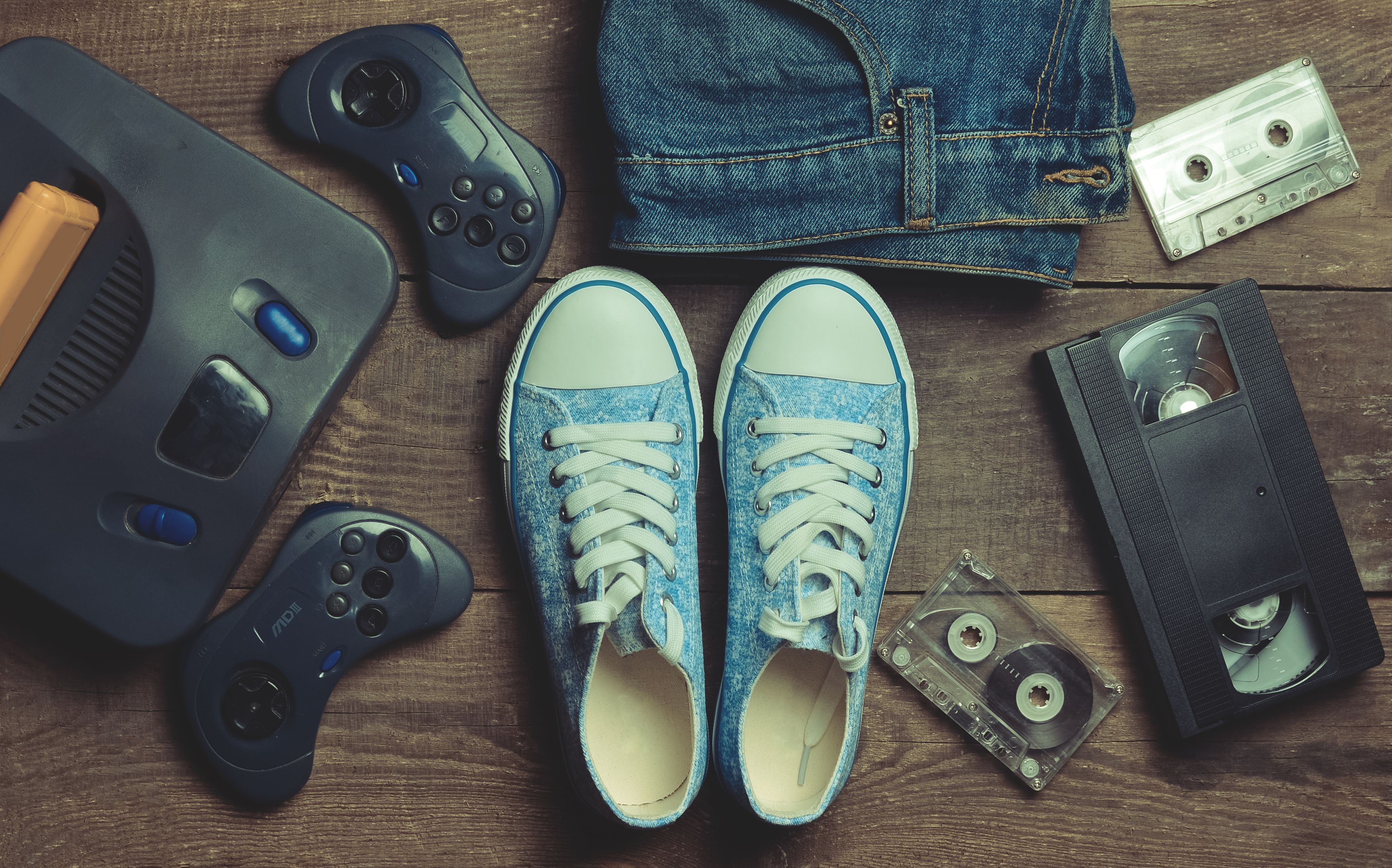
I was born into a childhood with no screens in it at all. My afternoons were spent in a drain behind our house, catching tadpoles and guppies with my bare hands, hunting insects with the single-minded focus that only a child with unstructured time can summon. We crushed grass to play shopkeeper. We read Archie comics until the spines gave way. If you wanted to make a friend on the other side of the world, you found a pen pal; and then you waited, for weeks sometimes, for a handwritten letter and whatever small gift they'd tucked into the envelope. I collected the stamps.

None of this was deprivation. It was simply what childhood was, for all of us who arrived a little too early for the digital age and a little too late to remain untouched by it.

Then I entered the workforce, and the machines began to arrive – slowly at first, and always slightly behind what I now know they were capable of.

My first job was as a junior graphic designer, and my computer had a black-and-white monitor. Monotone. If I needed to see actual colour – which, working in design, was rather often the point – I had to get up and walk across the room to the one machine that had it. I paced between those two computers more times a day than I could count, and at the time, it didn't occur to me to find this strange. It was simply how the work got done.

By my second job, the internet had arrived – but only on one computer, placed in the centre of the room where everyone could see exactly what you were doing. You could send an email, but everyone shared the same address, and everyone could see you typing it. The dial-up made a sound you could recognise from three desks away, and there was no pretending you hadn't been on the internet when your boss walked past – the evidence was audible before you'd even finished loading the page. We thought it was extraordinary anyway. I found people on ICQ. I sat in chatrooms making friends as far away as New York, astonished that this was even possible.

I learned PageMaker. I learned FreeHand. I learned QuarkXPress. I learned Photoshop. Within a handful of years, three of those four skills were essentially obsolete – replaced, absorbed, or simply abandoned by an industry moving on to the next thing. I watched colour separation houses close their doors. I watched offset printers – the same companies that had once dominated the entire creative industry, that we'd once queued to get time with; scale down, consolidate, and in some cases disappear entirely.

I tell you all of this not as nostalgia, though there is plenty of that in it too. I tell you this because I want to be absolutely clear: I am not new to technological upheaval. I have lived through more of it, more completely, than most people currently telling Gen X how to "adapt" have ever had to. I know what it is to watch an entire skill set become worthless within a professional lifetime. I have done it more than once.

And yet.

This time feels different. And for a long while, I couldn't work out why — until I realised it wasn't the scale of the change that was disorienting me. It was the speed.

Every previous wave I lived through arrived gradually enough that you could feel yourself adapting in real time. The black-and-white monitor became a colour one. The communal internet computer became a computer on every desk. PageMaker gave way to InDesign gave way to newer versions of InDesign.
There was always a runway – sometimes a short one, but a runway nonetheless – during which you could feel the ground shifting under you and adjust your footing accordingly.

This wave did not offer a runway. It arrived, by any honest measure, fast and furious, and it caught an enormous number of capable, experienced, intelligent people entirely by surprise – myself very much included.

And here is the part that nobody seems to be saying out loud, particularly not to or about Gen X: we are not really talking about this. We are doing what we have always done, which is picking ourselves up, dusting off, and quietly making a list of what we might need to retrain in next. There is no fuss. There rarely is, with us. We are the generation that grew up believing resilience was a private matter – you simply got on with it, and you did not make it anyone else's problem.

But privately, if I am honest with myself, it still feels like I am standing a few steps behind where I ought to be. Not because I haven't tried. Not because I lack the capacity. Simply because the ground moved faster than my feet this time, and no one warned me it would.

I do not know if I am the only one who feels this. I suspect, quite strongly, that I am not.

So what do we actually do?

I think the honest answer is: not immediately what we're being told to do.

Every piece of advice currently circulating tells us to retrain, to upskill, to get ahead of the curve before it's too late. And there will be a place for that — genuinely, there will. But I want to suggest something that feels almost heretical in a culture obsessed with productivity and adaptation: before we retrain, we might need to heal.

We have, across our working lives, absorbed an extraordinary number of transitions without ever being asked how we felt about any of them. We simply adapted, one obsolete skill at a time, one closed industry at a time, one communal internet computer at a time, and we called it resilience because that was the only language available to us. Nobody offered us space to grieve the version of our expertise that became worthless overnight. Nobody asked whether we were tired.

We are allowed to be tired now. We are allowed to feel displaced without immediately converting that feeling into an action plan. We are allowed, for a moment, simply to be – rather than to do, achieve, retrain, and adapt on command, the way we have quietly done every single time before.

I don't say this to suggest we stay still forever. We won't. Gen X has never been a generation that stays still for long. But I do think the adapting will go better –  will be more honest, more sustainable, and frankly more ours – if we let ourselves feel the ground shift first, rather than immediately springing into the next reinvention because that is what has always been expected of us.

So here is what I am doing, for now, and what I would gently suggest to anyone reading this who recognises themselves in it: give yourself permission to sit with the displacement before you try to solve it. Name what you have lost, however small it seems next to everything else you've survived. Let it be disorienting without needing to immediately prove that you are handling it well.

The retraining will still be there when you are ready. It always has been. But you have earned the right, after everything, to heal first.